
How much your car is worth in Calgary depends on who’s answering the question. The real problem is that these numbers were never measuring the same thing to begin with. An online estimate reflects generalized market data pulled from comparable listings, while a dealer’s trade-in figure reflects what they can resell the vehicle for after their own costs and margin. A cash offer reflects what one specific buyer will pay for your specific car today, based on its actual condition. Treating any single one of these as your car’s true value is exactly where sellers end up with unrealistic expectations before a sale even starts.
This blog explains what each of these numbers actually represents, what factors move car value in Calgary up or down, and how to build a realistic range before you sell, so you already know roughly what to expect once an offer comes in.
Why Does the Same Car Have Different Values?
There is no single correct figure. A vehicle’s realistic value in Calgary depends on the vehicle itself, its condition and history, current local demand, and which type of buyer you’re selling to. Understanding what determines used car value in Calgary, and why different buyers produce different numbers, is the most useful starting point before any sale.
The same vehicle can generate at least four distinct numbers depending on who’s assessing it and why. Start with an online estimate: it uses generalized market data based on the details you enter, so it’s a market value reference point, not a purchase offer. A private-sale asking price is different again, since that’s simply what a seller chooses to advertise, not necessarily the actual selling price the vehicle will fetch. A dealer’s trade-in value comes from a different calculation entirely, reflecting what the dealer can profitably resell or wholesale the vehicle for after their own costs and margin. And a cash buyer’s offer is different once more, a transaction-specific assessment based on the actual vehicle in front of them, its condition, local demand, and their own economics.
These numbers can all be different for the same car on the same day. An estimate from a valuation tool reflects a calculated range based on available market data, useful context, but not a commitment from any buyer. An asking price on a listing platform shows what a seller hopes to receive, not the actual selling price a buyer agrees to pay. Treating asking prices as transaction prices consistently overstates what a vehicle will realistically fetch.
What Factors Affect My Car's Value?
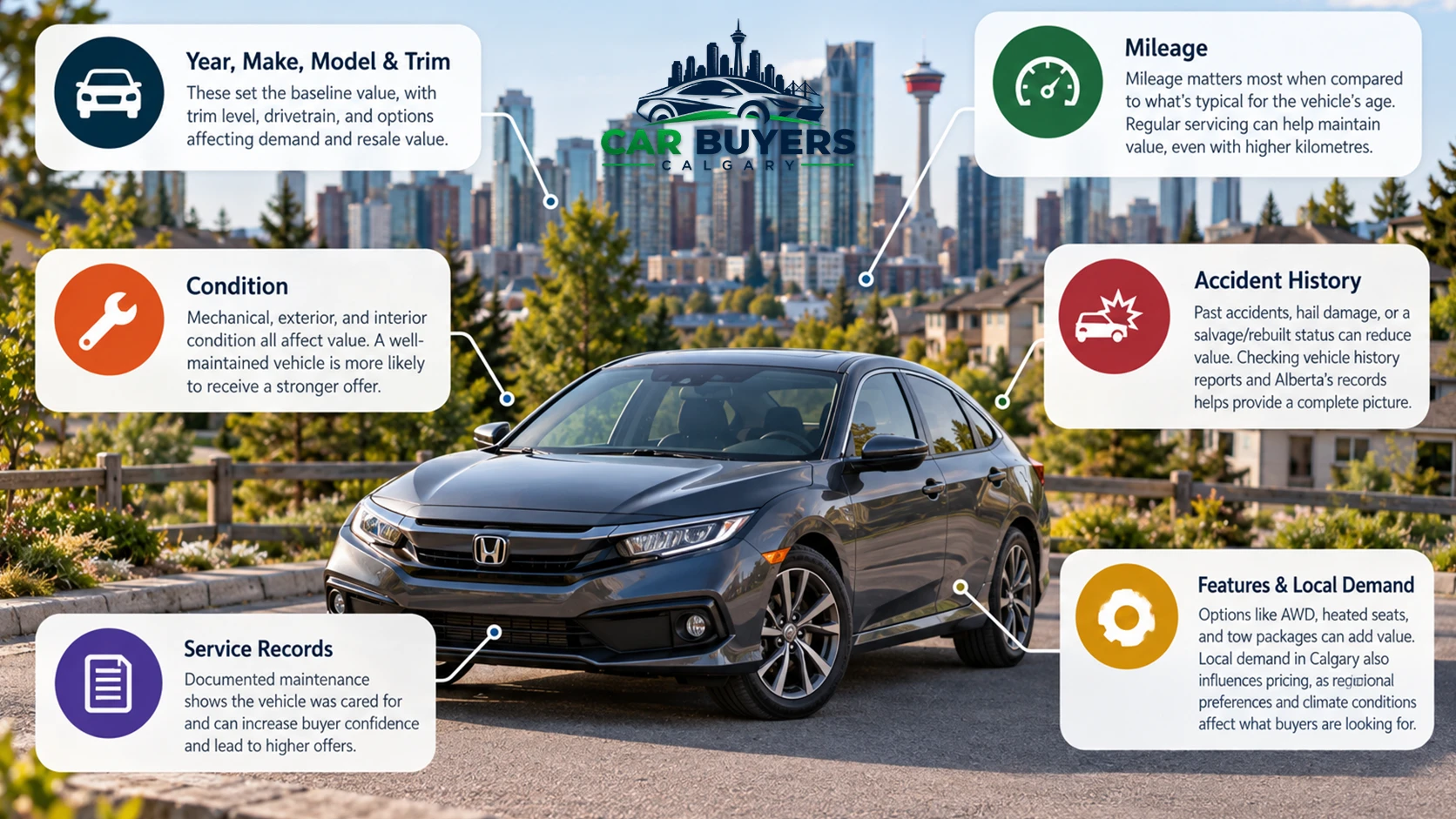
Several vehicle-specific and market factors shape what a buyer is likely to pay. Each one is explained below in terms of what it is, why it affects value, and how it can influence a cash offer.
How Do Year, Make, Model, and Trim Shape Value?
These form the baseline of any car valuation. Two vehicles from the same model year can have meaningfully different values depending on trim level, drivetrain, and factory options. A base-trim sedan and a higher-trim version of the same model with all-wheel drive and advanced safety systems are not the same vehicle from a buyer’s perspective. Make and model also influence how quickly a vehicle moves in the Calgary market. Models with strong local demand and a large existing ownership base tend to hold resale value better because more buyers are actively looking for them and more shops service them.
How Much Does Mileage Really Matter?
Mileage affects value because it’s a proxy for depreciation and expected remaining useful life. What matters is not the kilometre reading in isolation but how it compares to what is typical for a vehicle of that age, make, and model. CARFAX Canada, which uses odometer readings as one of its core valuation inputs, notes that a lower odometer typically shows better than a higher one, but that regular servicing alongside the mileage tells a more complete story. A high-kilometer vehicle with full documented maintenance can hold more value than a lower-kilometre one with no service history and unknown mechanical condition.
What Counts as Mechanical and Overall Condition?
Buyers evaluate vehicle condition across three separate areas rather than one general impression. Mechanical condition is whether the engine, transmission, and drivetrain are actually functioning correctly, with no known defects hiding underneath. Around the outside, exterior condition takes in the body panels, paint, glass, and tires, along with any structural damage from hail, rust, or a past collision. Inside, it comes down to the seats, dashboard, headliner, and electronics. How much each of these matters depends on who’s buying: cosmetic condition carries more weight for a privately sold daily driver, while mechanical integrity matters more to a parts-recovery or scrap buyer.
How Does Accident History Affect Value?
A vehicle’s history can affect both its marketability and how buyers perceive its value. CARFAX Canada’s 2025 data found that 1 in 4 vehicles searched had damage or accident history. Alberta also led the country in weather-related vehicle damage claims in 2025, with hail alone accounting for $414.8 million of it, more than any other province. That’s relevant context for Calgary sellers, since hail damage history is more prevalent here than in most Canadian markets. A recorded accident on a vehicle history report can reduce buyer confidence even if repairs were done correctly. The severity of the incident, whether the vehicle was given a salvage or rebuilt status, and whether repair documentation is available all factor into how much the history affects value.
Alberta also maintains its own vehicle records independent of any private history-report company. A Vehicle Information Report through the province’s registry shows registration history, and a separate personal property lien search shows whether any lien is registered against the vehicle. Both are worth checking alongside a CARFAX report, since a lien needs to be resolved before a sale can close cleanly, regardless of which buyer you sell to.
Do Service Records Really Add Value?
Documented maintenance provides evidence that a vehicle was looked after. Service records showing regular oil changes, brake work, and scheduled maintenance intervals reduce uncertainty for a buyer evaluating a used vehicle. The less a buyer has to assume about a vehicle’s condition, the more confident they typically are in making a stronger offer. For cash and scrap buyers, service records carry less weight than for private buyers, but for a running vehicle being sold privately or traded in, having the records available is worth the effort.
Which Features and Local Demand Trends Matter Most?
Beyond trim level, specific factory options and packages affect value. A vehicle with a tow package, heated seats, or a backup camera appeals to a broader pool of buyers than a stripped base model. AWD and four-wheel drive configurations can have strong relevance in Calgary, where winter driving conditions and local use patterns influence buyer preferences for capable drivetrains.
The same vehicle can also command a different price in Calgary than in Toronto or Vancouver, because local buyer preferences, climate conditions, and vehicle use patterns differ. CARFAX Canada’s valuation methodology specifically uses province as one of its core inputs, because regional demand genuinely moves valuations. National averages from valuation tools may not precisely reflect what your specific vehicle is worth in the current Calgary market.
Why Is a Cash Offer Different From an Online Car Value?
An online valuation tool produces an estimate from generalized market data based on the information you enter. It uses year, make, model, trim, mileage, condition, and location to generate a range based on comparable vehicles and historical transaction data. CARFAX Canada’s valuation system, for example, draws on more than 90 percent of all Canadian vehicle listing data and adjusts for vehicle-specific history when a VIN report is run. What a tool cannot do is assess the specific vehicle sitting in your driveway.
A cash buyer’s offer reflects a transaction-specific assessment. Beyond the basic vehicle details, the buyer considers the actual condition of the vehicle, its history, what it costs to tow and transport, what reconditioning or repair may be needed, local demand for that make and model, and what the buyer’s own resale or recycling channel looks like. Actual condition and local parts demand alone can shift an offer significantly from what a generic estimate would suggest.
Different buyers also operate different business models with different costs, resale channels, and demand for specific vehicles. A dealer who can retail a vehicle on a lot values it differently than a cash buyer who will process it through a recycling channel. The same vehicle can legitimately attract different offers from different buyers without either being unreasonable.
Are Online Car Value Calculators Accurate?
They can be useful reference tools, but their accuracy depends on the quality of the information entered and how well their underlying data reflects your specific vehicle and local market. Car valuation in Calgary is shaped by regional factors, hail damage prevalence, Alberta-specific registration history, and local buyer demand, that national tools may not fully capture.
To get a more useful estimate, enter the correct year, make, model, and trim rather than approximating. Use the actual current odometer reading and select the condition that honestly reflects the vehicle, not the best-case scenario. Use a tool that allows you to specify your province or region, since national averages may not reflect Calgary market conditions. Checking active listings for the same make, model, year, trim, and approximate condition in the Calgary area also provides useful context, but listing prices are asking prices, not transaction prices. No single calculator or listing gives you the complete picture, which is why comparing more than one reference point consistently produces a more reliable range.
How Can I Estimate My Car's Value Before Selling?
If you want to find out what your car is worth in Calgary before requesting an offer, a practical approach produces a realistic range rather than a single number that may not hold up when a buyer inspects the vehicle. Used vehicle value in Calgary is best understood as a range built from multiple reference points.
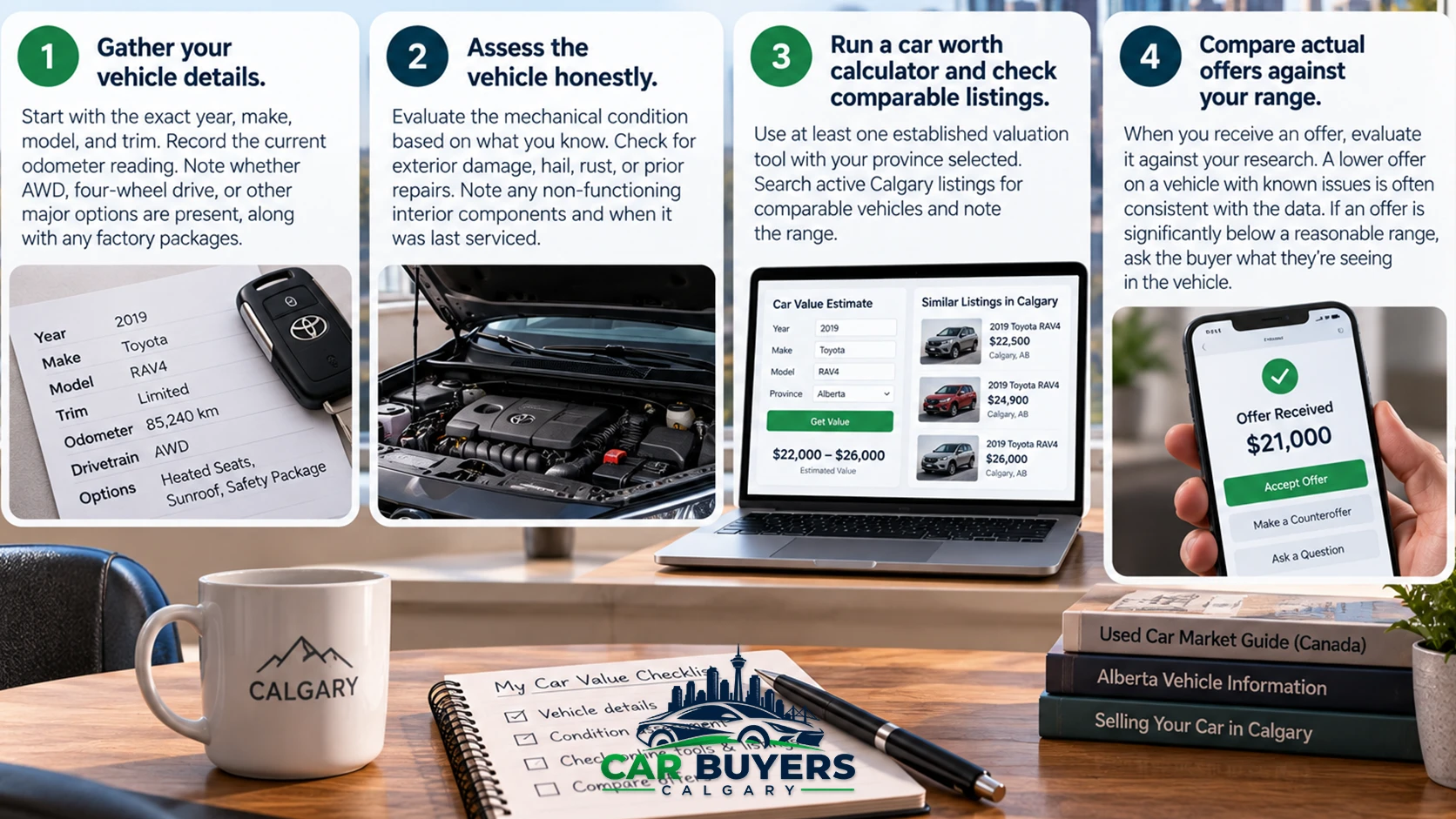
- Gather your vehicle details. Start with the exact year, make, model, and trim. Record the current odometer reading. Note whether AWD, four-wheel drive, or other major options are present, along with any factory packages.
- Assess the vehicle honestly. Evaluate the mechanical condition based on what you know: does it run, are there known issues, when was it last serviced? Assess the exterior for damage, hail, rust, or prior repairs. Note any non-functioning interior components.
- Run a car worth calculator and check comparable listings. Use at least one established valuation tool with your province selected. Search active Calgary listings for comparable vehicles and note the range.
- Compare actual offers against your range. When you receive an offer, evaluate it against your research. A lower offer on a vehicle with known mechanical issues or accident history is often consistent with what the data would predict. An offer significantly below any reasonable reference point warrants a direct question about what the buyer is seeing in the vehicle.
What Can Lower or Increase a Car's Value?
The same factors discussed above generally work in one of two directions, either pulling a vehicle’s value down or supporting it, depending on how they show up in your specific car.
Factors That May Lower Value
A handful of factors consistently pull a vehicle’s value down, regardless of buyer type:
- Higher mileage relative to the vehicle’s age, which reduces expected remaining life and buyer willingness to pay
- Significant mechanical issues, particularly with the engine or transmission, which reduce value across all buyer types
- Accident history, a salvage or rebuilt title, or undisclosed damage, all of which reduce buyer confidence and marketability
- Missing components, whether the catalytic converter, wheels, or other parts, which reduce what a buyer can recover from the vehicle
- Weak local demand for a particular make or model, which leaves fewer buyers competing for it
Factors That May Support Value
A similar handful of factors tend to work in the opposite direction:
- Lower mileage relative to the vehicle’s age, especially when paired with honest overall condition
- Desirable trim levels, AWD drivetrains, and popular factory options, which increase appeal in the Calgary market
- Documented maintenance history, which reduces uncertainty and can support a stronger asking price in a private sale
- A clean history report with no recorded accidents, which increases buyer confidence
- Strong local demand for the make and model, which means more buyers are actively looking
The same mileage, repair, or feature cannot be assigned one fixed dollar adjustment across every vehicle. The same additional 50,000 kilometres does not reduce every vehicle’s value by the same amount. It depends on the make, model, age, condition, and what is typical for that vehicle. Applying a universal formula to any single factor produces an estimate too imprecise to be useful.
How Do You Know If a Cash Offer Is Reasonable?
Compare the offer against valuation tool estimates and comparable active listings in Calgary, accounting honestly for the vehicle’s actual condition and any known history. A cash offer on a vehicle with mechanical issues or hail damage should be expected to sit below what a clean, running comparable would attract. That’s not a low offer, it’s an accurate one.
Check how the process works. For direct cash buyers, free towing and pickup are often included rather than deducted at the door. A slightly lower number with free pickup included may represent more net value than a higher-sounding number with a towing deduction applied at pickup. It’s also worth asking what vehicle information the buyer used. An offer based on accurate details you provided is more reliable than one made without knowing the actual condition, mileage, or history.
Getting a Cash Offer for Your Car in Calgary
If you’re wondering how much you’ll get for your car in Calgary, the most direct way to find out is to request a transaction-specific cash offer based on your actual vehicle. Car Buyers Calgary provides cash offers for vehicles across Calgary and the surrounding Alberta region based on the vehicle’s exact details, condition, and current market factors, not a generalized estimate.
Accurate vehicle details, the current odometer reading, an honest description of the mechanical and physical condition, and any known history help produce an offer that reliably reflects what the vehicle is worth. Car Buyers Calgary considers vehicles across a wide range of conditions, including running and non-running vehicles, accident-damaged and hail-damaged vehicles, flood or fire-damaged vehicles, and vehicles with salvage titles that dealerships typically decline. Free pickup is included across Calgary regardless of condition, same-day service is available in most areas, and payment is made at pickup with all transfer paperwork handled at your location.
Call (587) 330-3703 or email hello@carbuyerscalgary.ca with the year, make, model, mileage, and a brief description of the vehicle’s condition to get a firm, no-obligation offer.
Frequently Asked Questions
There is no single answer. Your vehicle's value depends on its year, make, model, trim, mileage, condition, accident history, local market demand, and which type of buyer you're selling to. An online estimate, a dealer appraisal, and a cash buyer's offer can all produce different numbers for the same vehicle, since they're each measuring something different.
No single factor dominates every situation. Mileage, mechanical condition, accident history, trim and options, and local market demand all contribute. For private sales, overall condition and history tend to carry the most weight. For cash and scrap buyers, mechanical integrity, vehicle completeness, and make and model demand matter most.
Yes, but not in a fixed formula. Mileage matters relative to the vehicle's age, model, condition, and maintenance history. A well-maintained vehicle at higher mileage can hold more value than a lower-kilometre vehicle with unknown condition, since service history and mileage together tell a more complete story than mileage alone.
It can. A recorded accident on a vehicle history report can reduce buyer confidence and the offers a vehicle attracts, even when repairs were done properly. The severity of the incident, the vehicle's current status, and whether repair documentation is available all affect how much history impacts value. Hail damage history is particularly common in Alberta specifically.
An online valuation tool produces an estimate from generalized market data based on the information you enter. A cash buyer's offer reflects a transaction-specific assessment of the actual vehicle, its condition, local demand, and the buyer's resale channel. Both are legitimate, but the estimate is a market reference while the offer is what one buyer will pay today.
They're useful reference tools rather than guaranteed purchase prices. Their accuracy depends on the quality and completeness of the information entered and how well the underlying data reflects your specific vehicle and local Calgary market conditions. Comparing more than one tool against active local listings gives a more reliable range than relying on a single estimate.
Compare the offer against valuation tool estimates and comparable active listings in Calgary, accounting honestly for the vehicle's actual condition and history. Check whether free pickup is included, since that affects the net value of the offer, and ask what vehicle information the buyer used to arrive at the number.
Have the year, make, model, and trim ready, along with the current odometer reading, an honest assessment of mechanical and physical condition, any known accident or damage history, maintenance records if available, and notes on missing or non-functioning components. The more accurately you describe the vehicle upfront, the more reliable the estimate or offer will be.
Final Thoughts
A vehicle does not have one universal value. Year, make, model, trim, mileage, condition, accident history, features, local demand, and selling channel all shape what a buyer will pay. Online estimates are useful reference points built from generalized market data, while an actual cash offer reflects a buyer’s specific assessment of your specific vehicle.
These two numbers answer different questions, which is why they are often different figures. The most reliable approach before any sale is to gather accurate vehicle information, use more than one reference point, and evaluate any offer against a realistic range that accounts for the vehicle’s actual condition and history.
Refrences
- CARFAX Canada. Data-Driven Valuation: Market-Based and History-Based Value Methodology. go.carfax.ca: https://go.carfax.ca/data-driven-valuation
- CARFAX Canada. Used Car Value Guide: How to Find Out What Your Car Is Worth. carfax.ca: https://www.carfax.ca/learn/buying/carfax-used-car-value-guide
- CARFAX Canada. 2025 Year in Rear View: Used Vehicle History Insights. Via Business Wire. businesswire.com: https://www.businesswire.com/news/home/20251125632667/en/2025-Year-in-Rear-View-CARFAX-Canada-Unveils-Used-Vehicle-History-Insights-for-the-Year
- Government of Alberta. Vehicle Information Report. alberta.ca: https://www.alberta.ca/vehicle-information-report
- Government of Alberta. Personal Property Liens. alberta.ca: https://www.alberta.ca/personal-property-liens