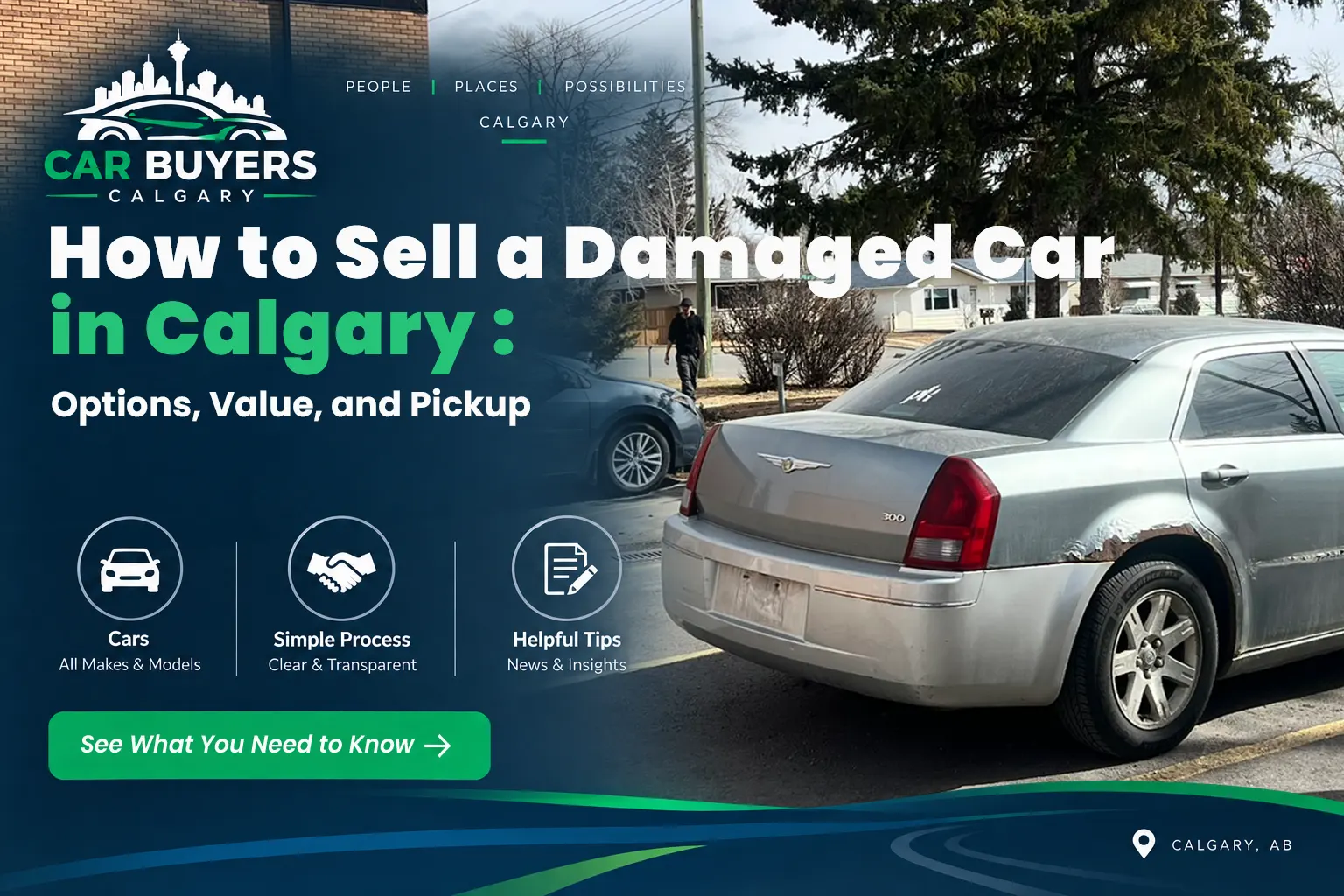

A cracked bumper and a bent frame are both “damage,” but they put a car in completely different sale predicaments. One barely changes who’ll buy it or what they’ll pay. The other can rule out a private sale entirely and turn a routine sale into a much narrower question. Spending money to repair a car that would have sold fine as-is, or writing off a car that still had real value, both come from skipping that step.
This guide walks through your realistic selling options, what actually moves a damaged car’s value, whether repairing it first is worth it, what a written-off or salvage-branded status changes, how pickup works once driving isn’t an option, and how to compare offers once you have them.
Getting a Cash Offer for a Damaged Car in Calgary
Car Buyers Calgary provides cash offers for vehicles across a range of conditions, including accident-damaged and hail-damaged vehicles, vehicles with mechanical issues, vehicles with no keys, and vehicles with registration or financing complications some buyers turn away. Free towing is included regardless of condition, same-day pickup is available in most areas, and payment happens at pickup with paperwork handled on-site. To get a quote, call (587) 330-3703 or email hello@carbuyerscalgary.ca with the year, make, model, and a description of the damage and the vehicle’s overall condition.
Can You Sell a Damaged Car in Calgary?
Yes. Damage narrows your buyer pool and changes how the vehicle gets valued, but it doesn’t take a vehicle off the market entirely. What matters more than the fact of damage is its type and severity.
Damage comes in a few distinct categories that affect a sale differently. Cosmetic and body damage, dents, scratches, hail damage, a cracked bumper, generally has the smallest effect on saleability, since the vehicle is often still mechanically sound and drivable. Mechanical damage, a failed transmission, a blown engine, or a serious electrical fault, cuts more directly into value and can affect whether the vehicle is safe to drive at all. Collision damage sits somewhere in between depending on severity, ranging from minor cosmetic repairs to structural damage that changes how a vehicle handles or whether it’s roadworthy. At the more serious end, a vehicle that’s been written off by an insurer carries its own status and requirements, which affects both value and who’s willing to buy it.
What Does a Written-Off or Salvage-Branded Car Mean for a Sale?
A vehicle that’s been written off by an insurer isn’t necessarily headed for the scrapyard, but it does carry a specific status that changes what a buyer can legally do with it. Alberta uses a few distinct categories, active, salvage, rebuilt, and non-repairable, and which one applies to your vehicle shapes the realistic selling options more than the damage itself does.
A vehicle branded salvage can’t be driven, sold as roadworthy, or registered again until it’s repaired and passes a Salvage Vehicle Inspection at a licensed facility, a process that involves a documented Rebuilt Vehicle Work Plan and photos taken before repairs begin. Once it passes, the status changes to rebuilt rather than reverting to active, and that rebuilt status stays attached to the vehicle permanently, visible to every future buyer, insurer, and lender who checks. A vehicle branded non-repairable is a different situation entirely: that status is permanent, the vehicle can never be re-registered, and it can only be sold for scrap or dismantled for parts.
None of this makes a written-off vehicle unsellable. It changes who’s realistically going to buy it and what they can legally do with it afterward. A salvage-status vehicle that hasn’t been rebuilt yet, or a non-repairable one, generally isn’t something a private buyer or dealer is set up to take on, which is exactly where a direct buyer familiar with these statuses becomes the more practical option.

What Is a Damaged Car Worth in Calgary?
There’s no fixed percentage that damage subtracts from a vehicle’s value, since the same type of damage affects two different vehicles differently depending on everything else about them.
Repair Needs Drive the Conversation
Repair needs sit at the center of how damage translates into value. A buyer looking at a damaged vehicle is generally pricing in what it would cost to fix, what parts or resale value the vehicle offers even without a full repair, and how much demand exists for that specific make and model. The vehicle’s other characteristics, year, mileage, overall condition outside the damage, and accident or maintenance history, still factor in alongside the damage itself rather than being overridden by it. Repair cost estimates matter to this conversation too, though a formal estimate isn’t something every seller has, and a buyer will often account for damage based on their own assessment rather than requiring one upfront.
Why Offers Can Vary Between Buyers
Different buyers can reasonably offer different amounts for the same damaged vehicle. A private buyer, a dealer, and a direct cash buyer each have different tolerances for damage, different resale or recycling channels, and different costs baked into what they can offer. Our guide on how much your car is worth in Calgary covers this same underlying principle in more depth, just applied specifically to a damaged vehicle rather than a general one.
Should You Repair a Damaged Car Before Selling It?
Sometimes, but it’s a bet rather than a guaranteed way to increase what you’ll net from the sale. A repair can make sense when the fix is well-defined and inexpensive relative to the vehicle’s value, or when it would open up buyer options, like a private sale or dealer trade-in, that damage currently rules out.
Selling as-is tends to be more practical when the repair cost is uncertain, high relative to the vehicle’s value, or would take more time and effort than you’re able to put in. The risk with repairing first is that the cost isn’t automatically recovered in the eventual sale price. A buyer isn’t obligated to pay back what you spent plus a premium just because the work was done. Comparing your actual options means weighing a real repair estimate against a real offer for the vehicle as it currently sits, not assuming the repaired version is worth the unrepaired value plus whatever the repair cost.
What Are Your Options for Selling a Damaged Car in Calgary?
The three basic selling routes are still available with a damaged vehicle, but damage changes how realistic each one is. Our guide to how to sell a car in Calgary covers those routes in more depth.
| Method | How Damage Affects It |
|---|---|
| Private sale | Harder the more severe the damage, since most private buyers want a vehicle in reasonable, drivable condition |
| Dealer or trade-in | Often limited or declined for significant damage, since dealers are generally set up to resell rather than repair or recycle |
| Direct or cash buyer | Usually the most practical route for meaningful damage, since these buyers are typically set up to assess and price vehicles specifically in this condition |
This is part of why a direct cash sale tends to be the realistic path once damage moves beyond minor and cosmetic, not because it’s automatically the best number, but because it’s the option built around this exact situation. If you do attempt a private sale despite the added difficulty, Alberta generally treats privately sold used vehicles as “as is” unless otherwise stated, meaning defects after the sale are generally the buyer’s responsibility. That doesn’t make it acceptable to misrepresent the damage or its extent to a private buyer.
Can You Sell a Damaged Car That Does Not Run?
Sometimes damage and non-running status overlap, and sometimes they don’t. A car can be significantly damaged and still start and drive, just as a car can be completely undamaged and simply refuse to start. They’re related but separate questions worth answering honestly when you’re describing the vehicle to a buyer.
When a damaged vehicle also doesn’t run, transportation becomes a bigger factor than it would for damage alone, since you can’t drive it anywhere to make the sale easier. Giving a buyer accurate information about both the damage and the mechanical status, rather than describing only one, gets you a more reliable offer than leaving them to guess at the parts of the picture you didn’t mention. If your vehicle’s primary issue is that it doesn’t run, our guide on selling a broken-down or non-running car for cash in Calgary covers that specific situation in more depth.
How Does Pickup Work for a Damaged Car in Calgary?
Damage that makes a vehicle unsafe or impossible to drive usually means towing rather than delivering it yourself, and it’s worth sorting out the logistics before you’re deep into comparing offers. A buyer who’s already agreed on a number can still leave you with an unpleasant surprise if towing terms weren’t part of that conversation.
- Confirm who arranges and pays for towing. Some buyers include this in the quoted offer, while others expect the seller to handle it separately or deduct it from the final number.
- Ask whether your specific location affects anything. A vehicle at home, at a repair shop, or in a storage lot can each raise different access questions worth clarifying up front rather than discovering at pickup.
- Confirm the pickup timeline. This matters more if the vehicle is somewhere it can’t sit indefinitely, like a shop charging daily fees or a tow lot with its own storage costs.
What Information Do You Need to Sell a Damaged Car?
The more accurately you can describe the vehicle upfront, the more reliable the offer you get back, since buyers price in uncertainty when information is missing or vague. A description that undersells or omits part of the picture usually just means the offer gets revised downward later, once the buyer sees the vehicle in person.
- Year, make, model, and mileage. The baseline details any buyer needs before they can meaningfully assess anything else.
- The type and extent of the damage. Cosmetic, mechanical, or collision damage each get evaluated differently, so being specific rather than general helps.
- Mechanical condition separate from the damage itself. Whether the vehicle starts, runs, and drives, or has issues beyond whatever caused the damage.
- Accident and vehicle history, including whether the vehicle has been in previous accidents or carries a salvage or written-off status.
- Keys, ownership, and documentation. A signed bill of sale is standard for transferring ownership in Alberta, and if a loan or lien is registered against the vehicle, that’s worth confirming and resolving as part of the sale.
- The vehicle’s location and any pickup considerations, especially if it’s somewhere with limited access or time constraints.
How Do You Compare Offers for a Damaged Car?
The quoted number is only one part of what an offer is actually worth, and comparing purely on that number can mean missing a better overall deal. Two offers that look close on paper can end up meaningfully different once towing terms, payment timing, and any conditions attached to the quote are factored in.
- Compare the offer amount itself, ideally based on accurate details about your specific vehicle rather than a rough estimate given sight unseen.
- Check the towing and pickup terms. A slightly lower number with towing genuinely included can be worth more in practice than a higher one where towing gets deducted afterward.
- Check payment and transaction terms. When and how you’re paid, and what paperwork is needed at pickup, both affect how smoothly the sale goes.
- Ask whether the offer is conditional. A number given without seeing the vehicle can change once someone assesses it in person, so it’s worth knowing upfront whether the quote is firm or subject to inspection.
Getting a Cash Offer for a Damaged Car in Calgary
Car Buyers Calgary provides cash offers for vehicles across a range of conditions, including accident-damaged and hail-damaged vehicles, vehicles with mechanical issues, vehicles with no keys, and vehicles with registration or financing complications some buyers turn away. Free towing is included regardless of condition, same-day pickup is available in most areas, and payment happens at pickup with paperwork handled on-site. To get a quote, call (587) 330-3703 or email hello@carbuyerscalgary.ca with the year, make, model, and a description of the damage and the vehicle’s overall condition.
Final Thoughts
A damaged vehicle isn’t automatically unsellable, but the type and severity of the damage genuinely shape the process: which selling methods are realistic, how the vehicle gets valued, and what pickup looks like. Cosmetic damage barely narrows your options, while significant mechanical or structural damage usually points toward a direct cash buyer rather than a private sale or dealer trade-in.
The details worth getting right are an honest description of the damage, the vehicle’s other characteristics, and clear towing and payment terms, compared across the whole offer rather than the number alone. Getting those details straight before requesting a quote turns a vague guess at value into something you can genuinely compare.
FAQs
Yes. Damage narrows which selling methods are realistic, particularly private sale and dealer trade-in for anything beyond minor cosmetic issues, but a direct cash buyer is typically set up to assess and purchase vehicles in a wide range of damaged conditions.
There's no fixed answer, since value depends on the type and severity of the damage combined with the vehicle's year, mileage, overall condition, and history. A buyer generally prices based on repair needs, parts or resale value, and demand for that specific vehicle.
Generally, yes, though the amount depends heavily on the severity and whether the damage is cosmetic, mechanical, or structural. A minor cosmetic repair affects value far less than damage that impacts safety, drivability, or the vehicle's frame and overall structure.
Sometimes, if the repair is well-defined and inexpensive relative to the vehicle's value. Repair costs aren't automatically recovered in the sale price, so comparing a real repair estimate against a real offer for the vehicle as-is is worth doing first.
Private buyers, dealers, and direct cash buyers all technically can, though their willingness drops sharply as damage becomes more severe. Direct cash buyers are generally the most consistent option once damage moves beyond minor and cosmetic issues on the vehicle.
Yes, though it's worth disclosing both the damage and the non-running status accurately, since they're related but separate factors a buyer needs to know about. A vehicle in this situation almost always needs to be towed rather than driven to the sale.
Yes, and towing is the norm rather than the exception once damage makes driving unsafe or impossible. Confirming who arranges and pays for it, and what the pickup timeline looks like, is worth doing before accepting any offer you receive.
Year, make, model, current mileage, the specific type and extent of the damage, mechanical condition, accident history, and whether keys and ownership documentation are available. More accurate, complete details generally lead to a more reliable, less negotiable offer once someone reviews it.
Generally, yes, though its Alberta status matters: a salvage-branded vehicle can't be driven or registered until it's repaired and passes inspection, while a non-repairable one can only be sold for scrap or parts. Direct cash buyers are usually better positioned than private buyers or dealers to take on either status.
Look past the headline number to the towing and pickup terms, payment method, and whether the offer is firm or conditional on an in-person inspection. Two offers that look similar on paper can end up meaningfully different once those details are factored in.
Refrences
Government of Alberta. Salvage vehicle inspections.
Government of Alberta. Standard bill of sale.
Government of Alberta. Personal Property Liens