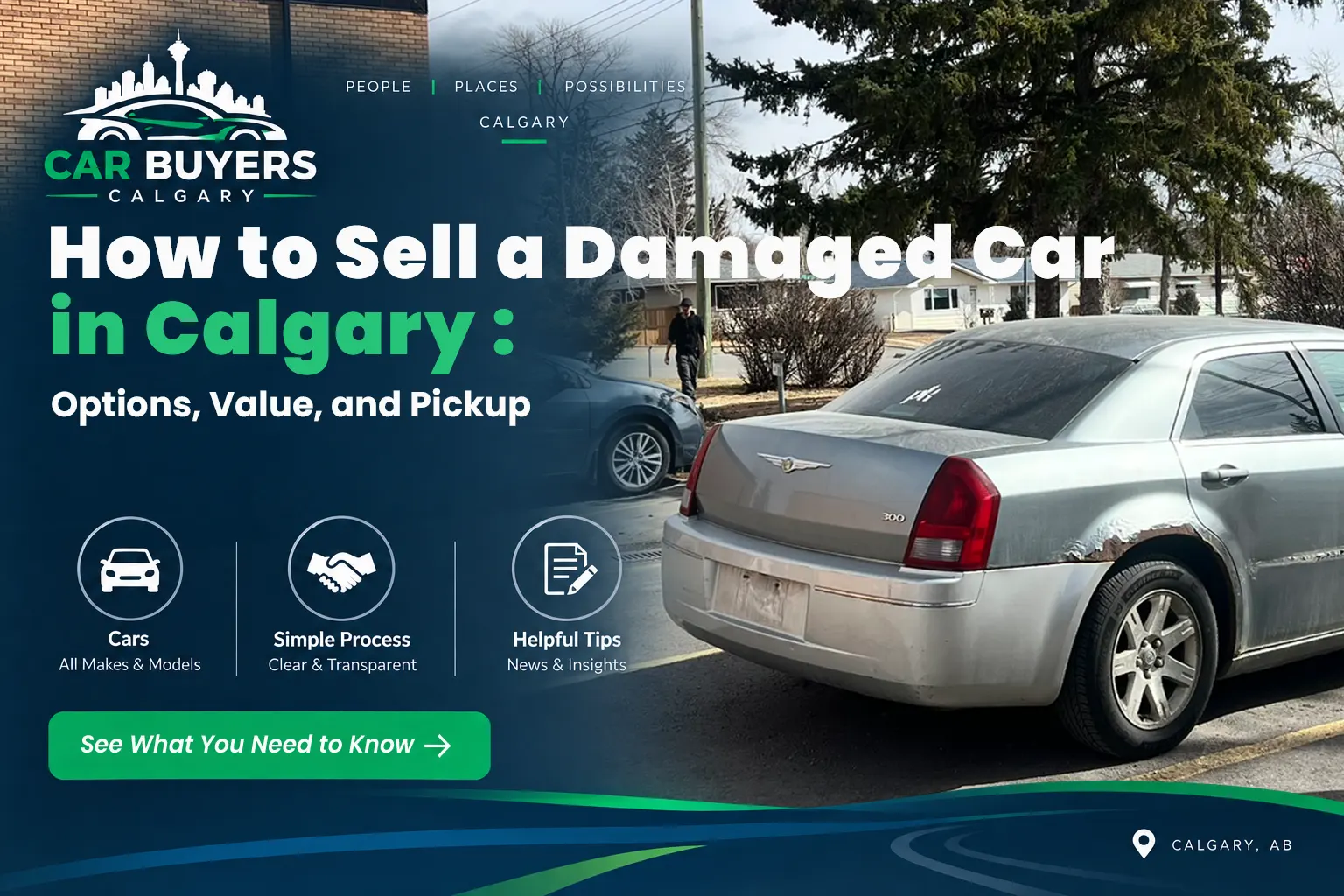

Owners looking to sell a broken-down car for cash often assume the vehicle needs to be fixed first, or that no one will take it seriously without a test drive. Neither is necessarily true. What matters is the vehicle’s identity, its actual condition, what documentation is available, and whether the buyer you’re talking to is even set up to handle a vehicle that can’t drive itself onto their lot.
This guide covers whether a non-running vehicle is genuinely saleable, what changes about its value, whether repairing it first makes sense, how towing and pickup work, what information to have ready, and how to compare offers once you start getting them.
Does a Car Have to Be Running to Be Sold?
No. A vehicle’s ability to be sold and its ability to start under its own power are two different questions, and non-running status closes off some paths, private sale and dealer trade-in becoming harder, without closing off the sale itself.
“Non-running” or “broken-down” covers a wider range of situations than people usually assume: a vehicle that simply won’t start, one with a major mechanical failure like a blown engine or transmission, one that’s technically drivable but not safely so, and one that’s just been sitting unused long enough that nobody’s sure what state it’s actually in. These aren’t all the same problem, and they don’t all point to the same outcome. A vehicle that won’t start because of a dead battery is in a fundamentally different position than one with a seized engine, even though both would be described as “not running” by their owner.
Whether it still has value depends on what’s underneath the “doesn’t run” label. A vehicle with a straightforward, fixable problem may still have resale potential once repaired, or scrap and recycling value if it doesn’t. Weight, parts demand, and overall completeness all factor into what a buyer working this way can offer, separate from whether the engine turns over. Not every buyer accepts every non-running vehicle, but enough buyers do that “it doesn’t run” is rarely the reason a sale falls through entirely.

What Affects the Value of a Non-Running Car?
Value for a non-running vehicle still comes down to a mix of general vehicle factors and condition-specific ones, though the two carry different weight than they would for a car that starts and drives normally.
The General Factors Still Apply
The general factors that shape any vehicle’s value, year, make, model, trim, mileage, and overall condition, still apply to a non-running vehicle. Our guide on how much your car is worth in Calgary covers those factors in more depth.
What's Different When the Vehicle Doesn't Run
What’s different for a non-running vehicle is that the mechanical problem itself moves from a minor detail to a central one. A dead battery or a simple sensor issue is a different situation for a buyer than a blown engine or a vehicle that’s been sitting exposed to the weather for years, since the second scenario shifts the value conversation from “what’s this car worth” to “what’s recoverable from it.” Accident history, maintenance records, and equipment still matter too, but they carry less weight than they would for a running vehicle, since a buyer purchasing a non-running vehicle is generally pricing based on what they can realistically do with it rather than what it looked like on a used-car lot. This is the core distinction behind trying to sell my broken down car for cash in Calgary rather than treating it like an ordinary used-car sale.
Should You Repair a Broken-Down Car Before Selling It?
Sometimes, but repairing first is a bet, not a guaranteed way to get more money. A repair can make sense when the fix is genuinely minor and inexpensive relative to the vehicle’s value, and when a running vehicle would open up private sale or dealer trade-in as realistic options that a non-running one doesn’t have.
Selling as-is tends to be the more practical choice when the repair cost is uncertain or high relative to what the vehicle is worth, when you don’t have the time or ability to manage the repair yourself, or when the vehicle’s age and condition mean a repair wouldn’t meaningfully change what a buyer is willing to pay. Repair costs aren’t automatically recovered in the eventual sale price, which is the core risk: spending money to fix a problem doesn’t guarantee a buyer will pay that money back, plus a premium, once it’s done. Comparing your options honestly means weighing a real repair quote against a real cash offer for the vehicle as it currently sits, rather than assuming the repaired version is worth whatever you spent plus the unrepaired value.
How Can You Sell a Non-Running Car in Calgary?
Non-running status changes how practical each selling method is, but generally these three options summarise how to sell a car in Calgary.
| Method | How Non-Running Status Affects It |
|---|---|
| Private sale | Significantly harder: most private buyers want to test drive and can't easily transport a vehicle that doesn't move |
| Dealer trade-in | Often limited or declined outright, since dealers are generally set up to resell running vehicles, not recondition or scrap them |
| Direct or cash buyer | Usually the most practical route, since these buyers are typically set up to assess, transport, and price a non-running vehicle specifically |
This is why a direct cash sale ends up being the realistic option for most non-running vehicles, not because it’s automatically the highest offer, but because it’s the option actually built around this exact situation. If you do go the private-sale route despite the added difficulty, Alberta generally treats privately sold used vehicles as “as is” unless otherwise stated, meaning defects after the sale are generally the buyer’s responsibility. That doesn’t make it acceptable to misrepresent the vehicle’s condition or history, particularly a problem you already know about.
How Do You Move a Car That Does Not Run?
A non-running vehicle almost always needs to be towed, since driving it to a buyer isn’t an option once it can’t safely move under its own power. This is worth confirming early, before you’re comparing offers, since towing terms can meaningfully change what an offer is worth in practice.
A few questions are worth asking any buyer before accepting an offer:
- Who arranges and pays for towing? Some buyers include this in their quoted price, while others deduct it or expect the seller to arrange it separately.
- Does pickup location affect the offer or the timeline? A vehicle in a driveway, a parking lot, or a storage yard can each present different access questions worth clarifying up front.
- Is there a specific pickup window, or same-day availability? This matters more if the vehicle is somewhere it can’t stay indefinitely, like a lot charging daily storage fees.
What Information Do You Need to Sell a Non-Running Car?
Having accurate details ready before you sell non-running car for cash gets you a number that reflects your vehicle, rather than a rough estimate that changes once someone sees it in person. Buyers working from vague or incomplete information tend to quote more conservatively, simply because they’re pricing in the uncertainty of what they haven’t been told.
- Vehicle details. Year, make, model, trim, and current mileage if it’s known or accessible.
- The actual mechanical problem, as specifically as you can describe it. Whether it won’t start at all, runs but can’t be driven safely, or has a specific known failure changes how a buyer assesses it.
- Keys, ownership, and documentation. Registration, ownership information, and whether keys are available all matter, and a missing key doesn’t necessarily prevent a sale, but it’s worth disclosing upfront rather than discovering during pickup. A signed bill of sale is standard for transferring ownership in Alberta regardless of the vehicle’s condition, and if there’s still a loan or lien registered against the vehicle, that’s worth confirming before you sell, since it needs to be resolved as part of the transaction.
- The vehicle’s exact location. Whether it’s at home, in a lot, or somewhere with limited access affects both the offer and how pickup gets arranged.
How Do You Compare Cash Offers for a Non-Running Car?
The quoted number is only part of the actual value of an offer, and comparing offers on that number alone can mean missing a better deal hiding behind different terms. Two offers that look identical on paper can end up meaningfully different once towing fees, payment timing, and any conditions attached to the quote are factored in.
- Compare the offer amount itself, based on accurate information about your specific vehicle rather than a generic estimate.
- Check the towing and pickup terms. A slightly lower offer with free towing included can be worth more in practice than a higher one where towing gets deducted separately.
- Check payment and transaction terms. When and how you’re paid, and what paperwork is required at pickup, both affect how straightforward the transaction ends up being.
- Ask what could change the offer. A number given without seeing the vehicle can shift once a buyer sees its actual condition, so it’s worth asking whether the quote is firm or subject to inspection.
Commonly Asked Questions
Yes. Non-running status limits some selling methods, particularly private sale and dealer trade-in, but a direct cash buyer is typically set up to assess, tow, and pay for a vehicle that can't be driven, regardless of what's wrong with it.
Usually, yes, though the amount depends heavily on the specific problem, the vehicle's overall condition, and what a buyer can realistically do with it. A minor issue on an otherwise solid vehicle is worth more than a major failure on one that was already in poor shape.
Yes. A car that won't start is one of the more common non-running situations, and it doesn't prevent a sale on its own. What matters more is why it won't start and what condition the rest of the vehicle is in.
Almost always, since it can't be driven to a buyer under its own power. Most direct cash buyers handle towing as part of the transaction rather than expecting the seller to arrange it separately, though it's worth confirming before accepting an offer.
The specific mechanical problem, the vehicle's year, make, model, and overall condition, and how much of it is realistically recoverable all play a role. A buyer purchasing a non-running vehicle is generally pricing based on what they can do with it rather than how it would look to a private buyer.
Sometimes, if the fix is minor and inexpensive relative to the vehicle's value. Repair costs aren't automatically recovered in the sale price, so comparing a real repair quote against a real cash offer for the vehicle as-is is worth doing before spending the money.
Often, yes. Missing keys can affect how a buyer assesses and prices the vehicle, but they don't automatically prevent a sale from happening. It's worth disclosing upfront so the offer reflects the actual situation rather than an assumption made later during pickup.
Year, make, model, mileage if known, a specific description of the mechanical problem, whether keys and ownership documentation are available, and the vehicle's exact location. More accurate details generally lead to a more reliable, less negotiable offer once someone actually sees it.
Getting a Cash Offer for a Non-Running Car in Calgary
Car Buyers Calgary provides cash offers for vehicles in a wide range of conditions, including non-running vehicles, accident-damaged and hail-damaged vehicles, vehicles with no keys, and vehicles with registration or financing complications that some buyers decline outright. Free towing is included regardless of condition, same-day pickup is available in most areas, and payment happens at pickup with paperwork handled on-site. To get a quote, call (587) 330-3703 or email hello@carbuyerscalgary.ca with the year, make, model, and a description of what’s wrong with the vehicle.
Final Thoughts
A broken-down or non-running vehicle isn’t worthless or unsellable, but its condition genuinely changes the process: which selling methods are realistic, how the vehicle gets valued, and how it gets from where it’s sitting to a buyer. Private sale and dealer trade-in become harder once a vehicle can’t be driven, which is usually why a direct cash buyer ends up being the practical option rather than the only option.
The details worth getting right are the vehicle’s actual condition, accurate documentation, and clear towing and payment terms, compared across the complete offer rather than the headline number alone. Getting those details straight before requesting a quote is what turns a vague sense of “it’s probably worth something” into an actual, comparable number.
Refrences
- Government of Alberta. Standard bill of sale. alberta.ca: https://www.alberta.ca/standard-bill-sale
- Government of Alberta. Buying a used vehicle in Alberta. alberta.ca: https://www.alberta.ca/buying-a-used-vehicle-in-alberta
- Government of Alberta. Personal Property Liens. alberta.ca: https://www.alberta.ca/personal-property-liens